
Hello, and welcome to another space deep dive! Here we focus on a topic and find books, movies, podcasts, and games so that you can fully immerse yourself in the subject. This week I’ll be covering the James Webb Space Telescope that was launched in 2021.
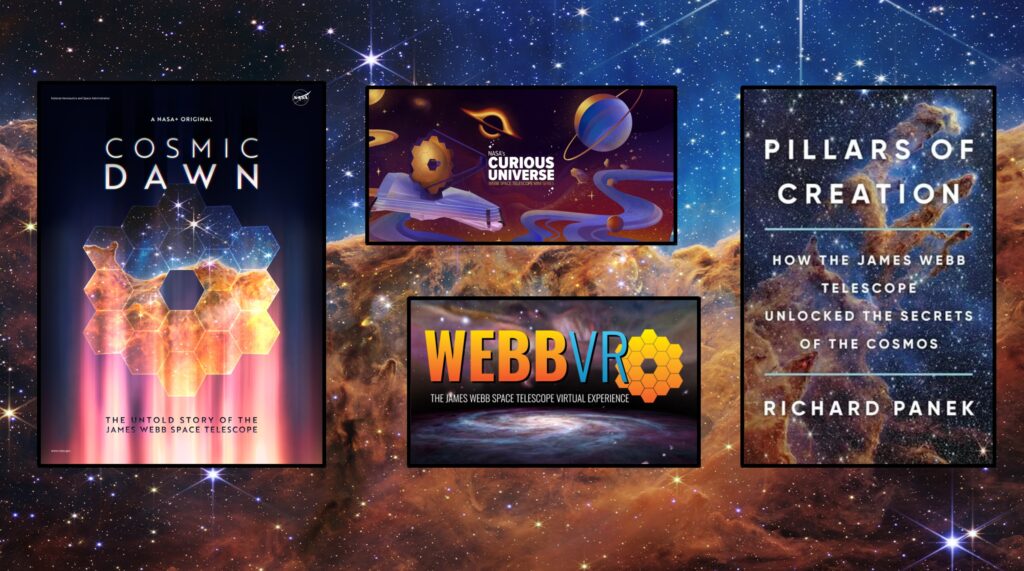
| Media | Title | Creator |
| Movie (Documentary) | Cosmic Dawn | NASA |
| Podcast | James Webb Space Telescope | NASA’s Curious Universe |
| Book | Pillars of Creation | Richard Panek |
| Video Game | WebbVR | Space Telescope Science Institute |
MOD-01 | The Projection Room
Cosmic Dawn
Rated: G
Runtime: 98 minutes
Cost: Free
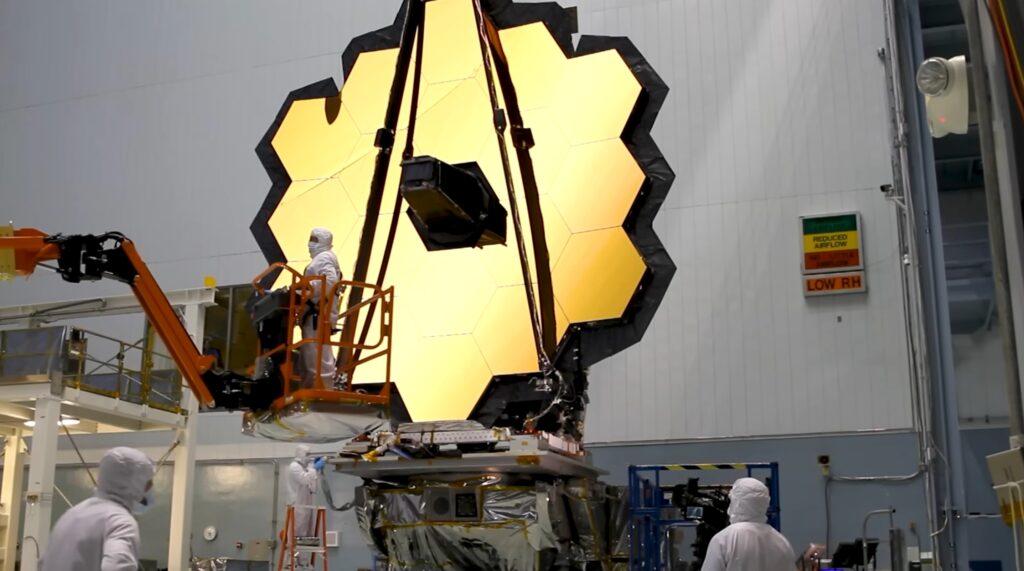
Cosmic Dawn is a movie that’s been in the making since 1995. It follows the James Webb Space Telescope (JWST) from its beginning concept and up to the first public reveal of some of the images taken. Along the way we meet the scientists and engineers who made it happen, as well as the truck drivers who transported JWST, and the communicators who followed this journey. I thought this movie was amazing and really highlighted the human aspect of this program. Science is cool, but seeing people do science is even cooler.
There was a moment that really stood out to me, when they were taking the covers off of the gold hexagonal mirrors that you see in the image above (the mirrors were facing upwards at this point). If even a single drop of sweat fell onto one of those mirrors during this process, it would set the mission back six months to a year. And yet, they completed this high stress task without losing a drop of sweat over it (pun intended).
To see this movie for yourself, you can watch it for free on Youtube or NASA’s website.
MOD-02 | The Comm-Link
James Webb Space Telescope – Curious Universe
Season: 10 | Episodes: 1, 3, 4, 5, and 6
Podcast Length: 121 minutes
I am once again recommending NASA’s Curious Universe for your listening perusal. This podcast synergizes really well with the Cosmic Dawn movie (and they also recommend at the end of every episode of this season that you go and watch Cosmic Dawn). Season 10 actually has seven episodes, but only five of them deal with the JWST and as such were the only ones I listened to. The first episode is an interview with Noble Laureate John Mather while the other four each cover a main topic of research that Webb is pursuing (galaxies, exoplanets, our solar system, and star origins).
For each episode they talked with an expert in that field. There’s a moment in the galaxies episode where the host Jacob Pinter asks Michelle Thaller (that episode’s expert) to fill in the blank of the sentence “The James Webb Space Telescope is teaching us ______ about galaxies” to which Michelle answers “Everything!” She’s joking, but she goes on to explain how it’s teaching us how galaxies form and evolve, and that galaxies we could see with Hubble, we can observe with even more detail now with JWST. We’re seeing closer and closer to the beginning of our universe.
You can listen to this on NASA’s website or wherever you get your podcasts.
MOD-03 | The Paper Observatory
Pillars of Creation – Richard Panek
Estimated Readtime: 3 to 4 hours
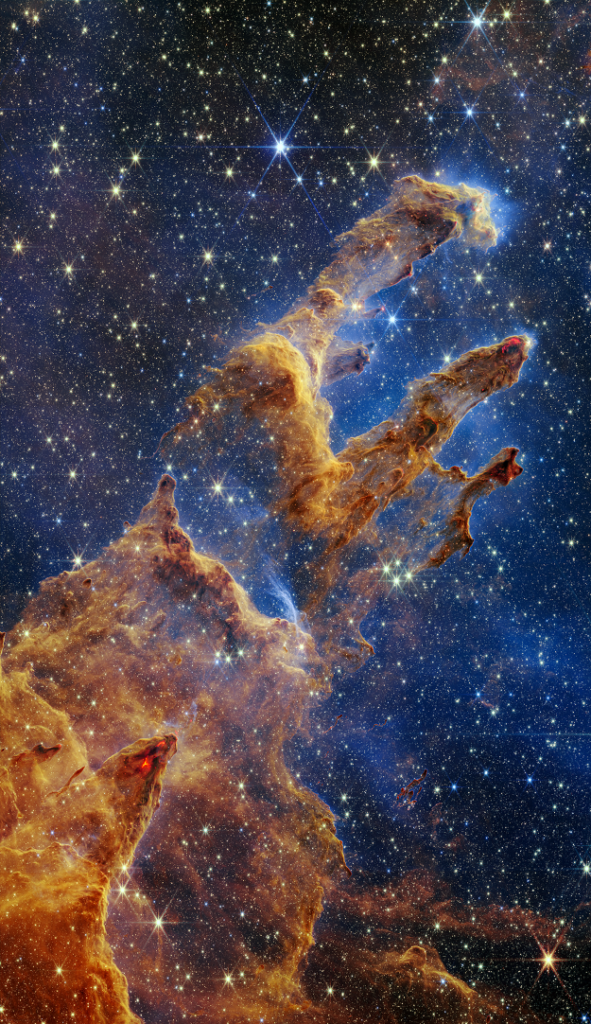
This book also covers the James Webb Space Telescope from creation to launch, but unlike Cosmic Dawn, it covers more of the science and observations that came out of the JWST. There were so many interesting little tidbits it contains, such as, one of the early suggestions for the JWST was to have it be a lunar observatory. Also, the debacle with the Hubble Space Telescope (the primary mirror had an aberration that was making images blurry) almost sunk the JWST. If they had been unable to fix Hubble, the appetite for more space telescopes would have probably been gone. But the most fascinating part to me was that NASA had to account for pirates when shipping JWST to its launch site. They had to make the freighter as inconspicuous as possible so as to not have the $8.8 billion cargo stolen before it can get to space. This is also touched in the Cosmic Dawn movie, where they describe that a talented individual was posting live updates of where the freighter was at and they had to politely ask that individual to make their updates less accurate.
You can find this book at your local library or bookstore.
MOD-04 | Digital Horizons
WebbVR
Rating: E
VR Headset Required
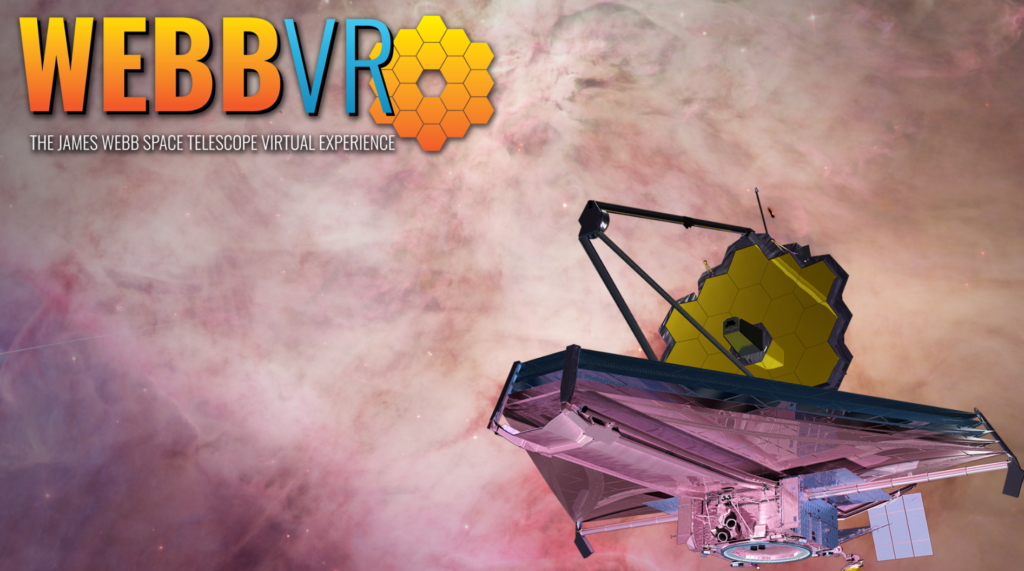
This is a gem I wish I had found earlier. It takes you on an initial tour and shows you where the JWST is right now in relation to Earth and the Moon, then hands you the reins to explore the universe. Not only can you zoom around the JWST learning facts about its construction and what each part does, but you can also visit other planets, stars, a black hole, our galaxy, and much more. You can tell that the folks who designed this really enjoyed what they were doing. They even hid little easter eggs that they don’t call out, for instance I found a detailed probe orbiting Saturn, but it would have been so easy to miss it if I hadn’t been getting up real close to the planet.
Pro Tip: The controls are a little bit hard to master, and turning is very slow. To go forward you hold down the trigger of your controller, but sometimes you can overshoot where you’re trying to get. Instead of patiently waiting to turn around, I suggest turning the controller to face towards you and pressing the trigger, thus shooting you in a backwards direction. No turning necessary!
Another Pro Tip: Don’t sleep on the travel portion of the menu. This is how you can get to the cool destinations like a black hole.
It took over 25 years for the JWST telescope to go from idea to reality, but now that it’s here, it’s updating so many things we know about the cosmos. The next telescope to reach space will be the Nancy Grace Roman Telescope, with a planned launch date before May 2027. Its objective is to settle essential questions in the areas of dark energy, exoplanets, and astrophysics.
Next week’s deep dive will be covering The First People to Mars. Until then, keep looking up!

Leave a Reply