


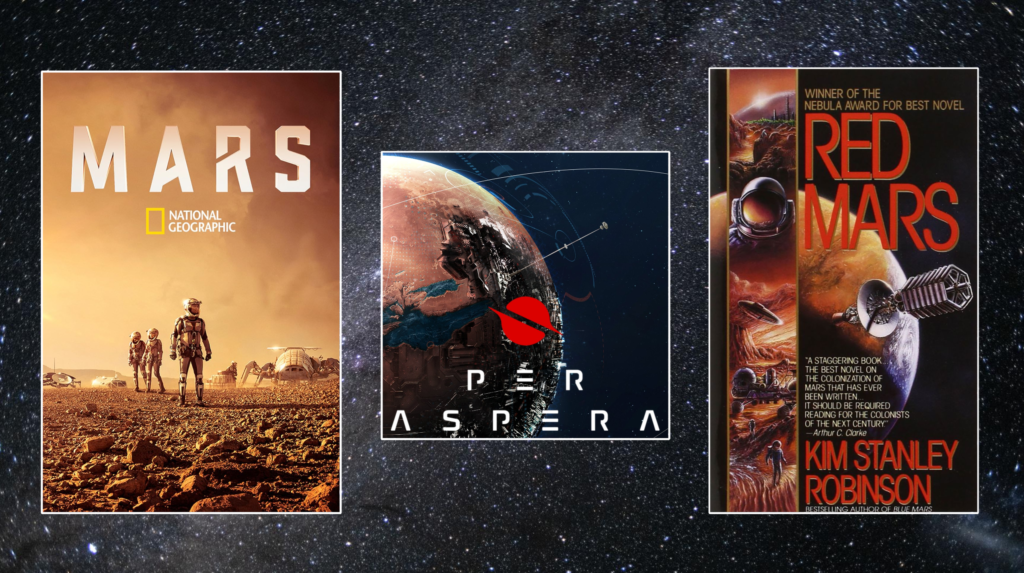
Hello, and welcome to the third and updated version of the space deep dive! Each week I focus on a new topic and find something you can watch, read, and play to learn more. This week is imagining the first humans on Mars, and what they’ll experience (I hope to visit this topic again in the future when actual people go to Mars).
So far, we as a species have only walked on one other surface that isn’t Earth, and that’s our nearest neighbor, the Moon. But what if we ventured further? What if we traveled to another planet? NASA is currently planning for this by using the Artemis program as a testing ground for technologies that we’ll need to make such a trip. It won’t be easy, which is why we’re building experience on the Moon first. Mars is on average 140 million miles away from us, while our Moon is only roughly 238,855 miles away. This is a vast difference in distance that humans would have to travel, and the earliest moment in time in the book Red Mars starts us on this journey.
Red Mars 📖
Kim Stanley Robinson
Estimated Readtime: 15 to 16 hours
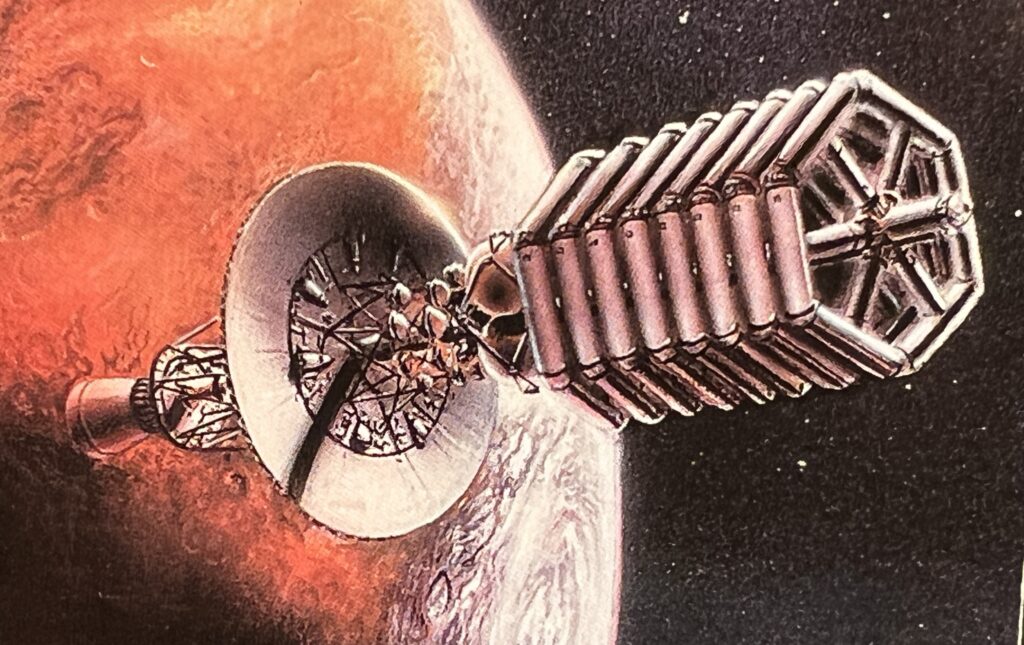
It is the far future, and the first 100 settlers from Earth are heading to Mars. The year? 2026. Ok, so that’s this year, but when this book was published in 1993 that was still three decades out. The author Kim Stanley Robinson utilized years of research to write this novel, and it still holds up in the 2020s. For instance, the design of the spaceship itself is pretty ingenious. Looking at the picture above you’ll notice eight separate rings around a central column. In the book, the author has those rings spinning at 4 revolutions per minute (RPM), which is how fast they would have to turn to imitate Mars gravity at 0.38 G (about one/third the strength of Earth’s gravity). This helps the colonists prepare for life on Mars, while also reducing the loss of muscle and bone mass during their trip.
After nine months they reach Mars (which is a long time, ask anyone who’s been pregnant, they’ll let you know). To be clear, this isn’t the first mission to Mars in this universe (it’s the second), but they are the first humans to go there to stay. As such, a lot of the equipment they need to make the first settlements have been pre-delivered. This includes digging equipment, tool sets, workshops, factories to pull chemicals and elements out of the air, a nuclear reactor, and much more. When you’re nine months away from the nearest store, you need to be sure that you have everything that you could possibly need. Not only that, but if you get injured on Mars, there’s no hospital to go to. You better have a physician and a full suite of medical devices to treat as many ailments as possible. Which leads us to MARS season 1, where one of the main characters gets injured in re-entry.
You can find this book at your local library or bookstore.
MARS Season 1 📺
National Geographic
Rated: TV-PG
Episodes: 6
Runtime: 4 hours and 30 minutes
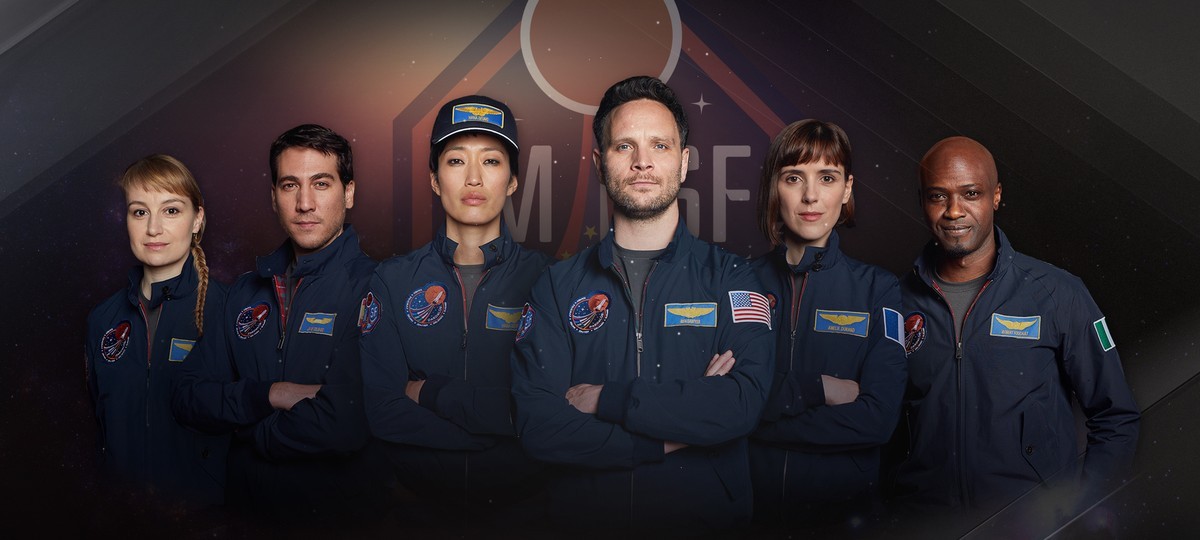
National Geographic’s MARS TV show takes a different approach to the first mission and humans to Mars. Instead of 100 people going, it’s only six. This seems pretty believable as a first mission, you wouldn’t want to send a lot of astronauts because that’s more people that are at risk. However you don’t want to send too few because again if something happens out there, it’s nine months until the next group can come to help out. Which is why one of the main crew members is a doctor whose skills come in handy when various crew members get injured throughout the show.
An interesting part of the format of this show is that it switches between 2033 (when the first Mars mission takes place), and 2016 (when the show originally aired). This allowed National Geographic to bring in experts in the field to talk about all the work that was happening at that time that could be used in future missions to the red planet. They delved into subjects such as psychological health, sustainability, and even the search for life on Mars. With all this information you’re able to get a pretty good picture of what the first humans on Mars experience would be like.
With a mission of this importance, a lot of it would be live streamed so you might get some views similar to what the TV show depicts. If you watched the Artemis II live stream, I feel like it would be very similar to that where you would see outside views of the spacecraft/base, have reporters and countries calling the astronauts for interviews, and have occasional interior views when projects or science experiments are being done on the surface. It will be the greatest reality TV show on Earth, with our hopes and dreams pinned on those first visitors to Mars. How will we get ready on Mars for those first astronauts? Per Aspera shows us one possible way.
You can find this show on National Geographic’s website, Disney+, or check it out from your local library.
Per Aspera 🎮
Tlön Industries
Rated: Everyone 10+
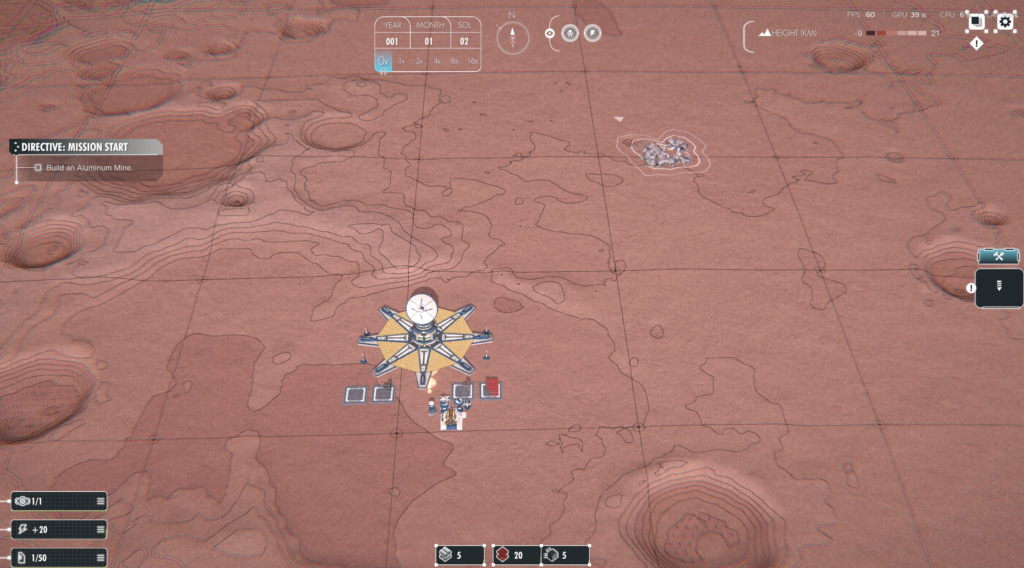
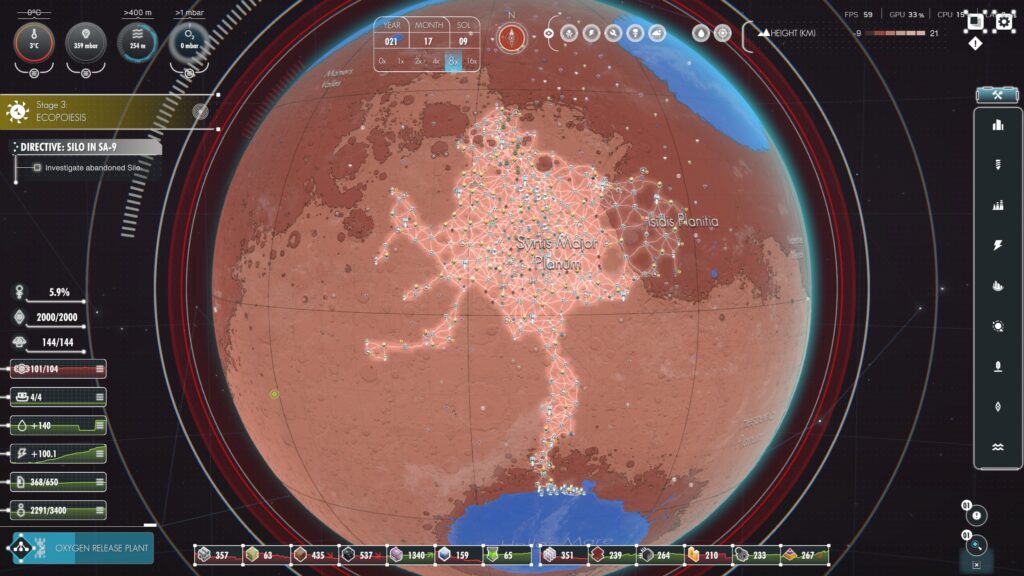
While Red Mars and the Mars TV show have the humans do a lot of the work on constructing and securing their settlements, Per Aspera takes a different route. What if there was one AI that controlled all the production of factories and utilization of Mars resources, and was in charge of building settlements? Enter the Artifical Machine Intelligence (AMI), which is you as the player. You start out with a single hub, a single rover, some steel and other resources, and are left to expand. You build factories to bring in more resources, which can then be used to both set up habitats and to begin terraforming the Martian surface.
A lot of infrastructure is built before the first humans can even arrive, which is plausible. However, a future mission will probably be a mixture of robotic pre-building and humans working on the surface. Some tasks are better suited for humans on site controlling robots, since a signal to Mars takes about six minutes round trip. This lag can be the difference between a rover falling into a chasm, or being stopped and piloted safely around the hazard.
Pro Game Tip: Be sure you mine lots of ice as soon as possible. Ice is needed not only so your colonists can drink, but is also necessary in making their food. I found myself running out quite often, and this problem was only exacerbated when the rising temperature of Mars started melting my ice deposits. Building water networks at that point is just as important. Life needs water!
While a mission to Mars is still far off, there is still plenty that scientists and engineers are doing now to prepare for this. If we’re lucky, all this work will lead us to seeing the first humans to land on Mars in our lifetimes. I’ll be watching. Will you?
Next week’s deep dive will be covering Making Money on the Moon. Until then, keep looking up!

Leave a Reply